Full Cycle Recruiting in 2026: The 6 Stages, and Where AI Actually Earns Its Keep
Full cycle recruiting means one recruiter, or one connected workflow, owns a hire from the first requisition to the candidate's first day. No handoffs between a sourcer, a screener, and a scheduler. One owner carries the candidate the whole way.
The model works because it removes the friction that builds up at every handoff. It breaks down the moment that same person has to do six jobs by hand, because manual full cycle recruiting does not scale much past a handful of open roles.
This guide walks through the six stages of full cycle recruiting, where each one typically stalls, and where AI now does the heavy lifting without taking the recruiter out of the decision. If you want the broader picture of what to automate first, our guide to recruiting automation in 2026 covers that in more depth.
What Full Cycle Recruiting Actually Means
Full cycle recruiting, also called full life cycle or end-to-end recruiting, puts one recruiter or one unified system in charge of every stage of a hire. That is different from a pod model, where sourcers, recruiters, and coordinators each own one slice of the funnel and pass candidates between them.
Neither model is automatically better. Full cycle recruiting tends to win for small and mid-size teams, and for roles where the candidate benefits from one consistent point of contact. A pod model tends to win at very high volume, where specialization outpaces the value of continuity.
What changed in 2026 is the ownership question itself. A single recruiter can now own more of the funnel than before, because AI handles the repetitive middle stages that used to require a dedicated coordinator or screener.
The 6 Stages of Full Cycle Recruiting
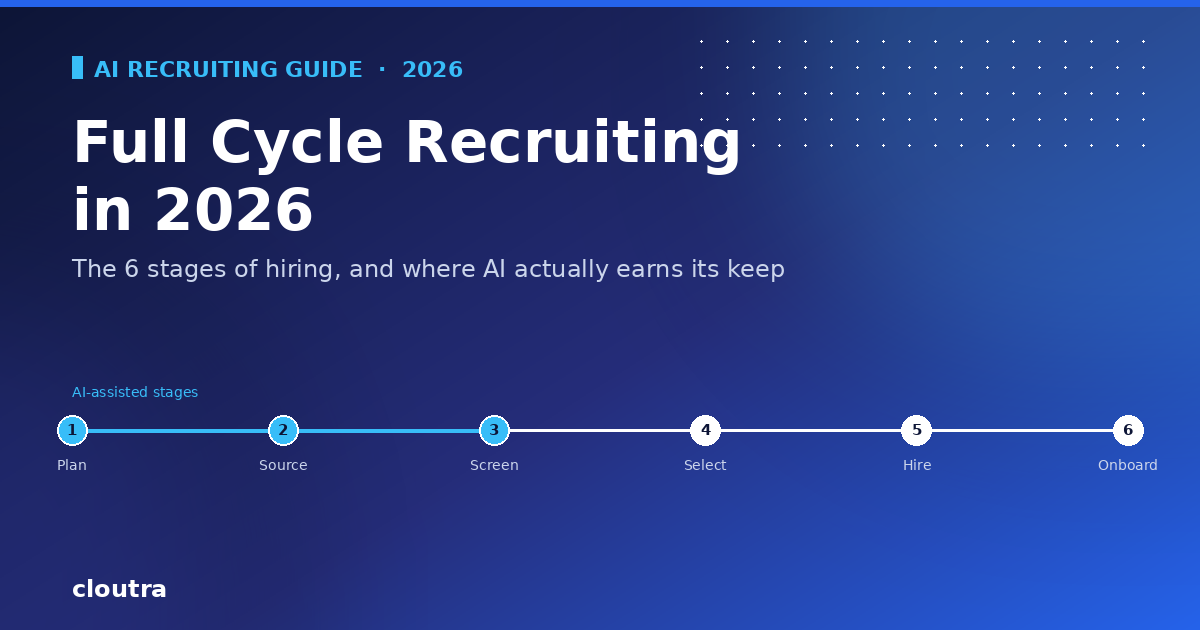
Most frameworks agree on the same six stages, sometimes with a workforce-planning step added at the front and a retention check added at the back. Here is what each stage actually involves.
- Workforce planning — Confirming the role is worth opening, aligning budget, and deciding whether to build the skill internally or hire for it.
- Sourcing — Writing the job description, posting it, and proactively reaching passive candidates through outbound and referrals.
- Screening — The first real filter. Resumes get reviewed against the role's actual requirements, not just keyword matches.
- Selecting — Structured interviews and assessments that compare every candidate against the same criteria.
- Hiring — Extending the offer, negotiating terms, and closing the candidate before a competing offer does.
- Onboarding — Getting the new hire set up, oriented, and productive, instead of treating day one as the finish line.
Screening and selecting are usually where a full cycle recruiter's week disappears. SHRM's 2026 benchmarking data puts screening and interviewing at roughly 8 to 9 days each, out of a median 39-day cycle for nonexecutive roles. That is close to half the entire hiring timeline sitting in two stages a recruiter fully controls.
Full Cycle Recruiting vs the Pod Model
Both models can produce good hires. The right one depends on volume, role complexity, and how much continuity candidates need to feel during the process.
Full cycle recruiting fits when
- You're hiring under roughly 20 to 30 roles a year
- Candidate experience depends on one relationship
- Roles are varied enough that specialization adds little
- You want clear accountability for each hire
A pod model fits when
- You're hiring at high volume for similar roles
- Sourcing and screening genuinely benefit from specialists
- Coordination overhead is cheaper than duplicated effort
- Recruiters are already stretched thin on their own
Where AI Actually Helps
Not every stage benefits equally from AI, and the label "AI-powered" covers very different technology depending on the vendor. Our breakdown of static, generative, and agentic AI in recruiting goes into that distinction in detail. In practice, three stages see the biggest gains.
Screening gets faster and more consistent
An AI-powered ATS grader scores every resume against the same role-specific criteria, instead of the criteria drifting as a recruiter gets tired or busy near the end of a long shortlist. This is usually the single biggest time recovery in the whole cycle.
Selecting becomes structured by default
An AI interviewer can run a first-round interview using a fixed structure, such as the STAR method, so every candidate answers the same questions in the same order. That structure is also what makes the results explainable later, which we cover in our guide to AI interview scoring.
The full funnel stays connected
The real value shows up when screening, interviewing, and shortlisting sit inside one workflow instead of three disconnected tools. That is the core idea behind an AI recruiter built to manage the funnel end to end, so a recruiter reviews a ranked shortlist instead of stitching results together by hand.
"What used to take days now takes hours, without losing the human touch in the process."
— Ryan Kessler, Director of Talent Acquisition at Bridgeway Logistics
Where AI Should Not Take Over
Full cycle recruiting still needs a human for the calls that carry real judgment. Offer negotiation, culture-fit conversations, and the final hiring decision all benefit from a recruiter who knows the context an algorithm never sees.
There's also a compliance reason to keep a human in the loop. Any screening step, automated or manual, can create adverse impact if it quietly filters one group out at a different rate than another. Full cycle recruiters running AI tools still need to check that their shortlist reflects the applicant pool, not just a faster version of the same bias.
Own the full funnel without owning six manual jobs
See how Cloutra's AI Recruiter connects ATS grading, AI interviews, and candidate ranking into one workflow for full cycle recruiters.
The Metrics That Tell You If It's Working
A full cycle process is only as good as the numbers behind it. Three figures matter most, and they're worth tracking every quarter rather than glancing at once a year.
- Time to fill. SHRM's 2026 benchmark sits at a median of 39 calendar days for nonexecutive roles, down from 44 in 2025, and 45 days for executive roles.
- Where the days go. Screening and interviewing each average 8 to 9 days, making them the highest-leverage stages to tighten first.
- Candidate experience. A faster process only helps if candidates still feel informed and respected along the way. Our guide to candidate experience metrics covers how to measure that properly.
For the full benchmarking methodology and the latest figures by role type, SHRM's recruiting benchmarking research is the most current public source.
Frequently Asked Questions
What's the difference between full cycle and full life cycle recruiting?
Nothing meaningful. Full cycle recruiting, full life cycle recruiting, and end-to-end recruiting all describe the same model: one recruiter or one system owns every stage of a hire, from requisition to onboarding.
Can one recruiter really run full cycle recruiting at scale?
Manually, not much past 20 to 30 roles a year. With AI handling screening and first-round interviews, a single recruiter can own a meaningfully larger caseload while still making every final decision themselves.
Does AI replace the full cycle recruiter?
No. AI takes over the repetitive, high-volume middle of the funnel, resume screening and first-round interviews mostly, while the recruiter still owns sourcing strategy, candidate relationships, negotiation, and the final call.
What's a good time-to-fill benchmark in 2026?
SHRM's 2026 data puts the median at 39 calendar days for nonexecutive roles and 45 days for executive roles. Under 30 days is generally considered strong for standard nonexecutive hiring.
Ready to See the Future of AI Recruiting?
Discover how Cloutra AI automates resume screening, schedules AI interviews, and evaluates candidates, helping your team hire faster and make better recruiting decisions.